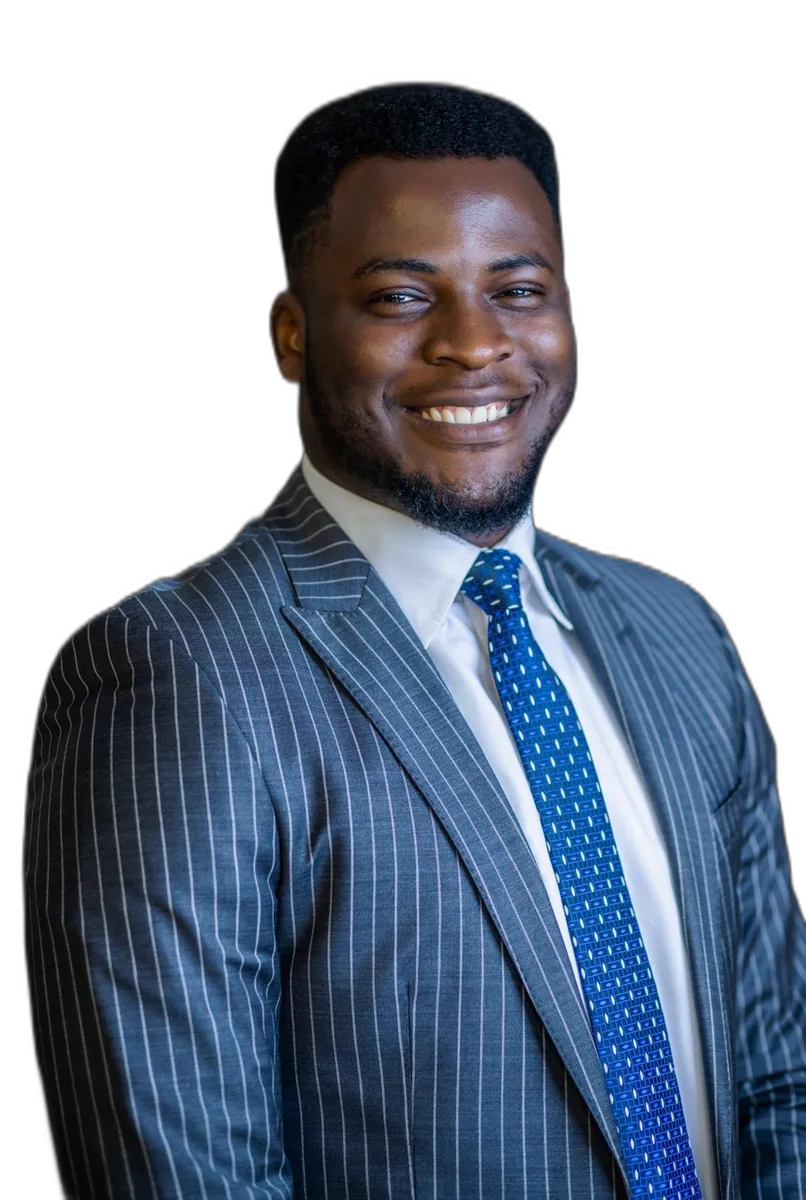
Chukwuebuka Christian Ogbodo
News & Insights
A record of work — in infrastructure, legislation, technology policy, and democratic governance. Sourced and referenced.
Chukwuebuka Christian Ogbodo
A record of work — in infrastructure, legislation, technology policy, and democratic governance. Sourced and referenced.
As part of the Templars legal team, Ogbodo advised project sponsors on the $629 million financing for the Lekki Deep Sea Port — Nigeria’s first deep sea port and the deepest in Sub-Saharan Africa.
The Lekki Deep Sea Port is the single largest private infrastructure investment in Nigerian history, developed on a non-recourse project finance basis with majority international financing.
The port’s Phase 1 alone cost $1.53 billion, financed through a landmark $629 million loan facility from the China Development Bank signed in October 2019, alongside equity from an international consortium led by the Tolaram Group of Singapore and China Harbour Engineering Company.
Ogbodo was named on the Templars advisory team — led by Chike Obianwu and Finance Partner Zelda Akindele — that advised the project sponsors on the transaction. The deal was subsequently named “African Infrastructure Deal of the Year.”
The port, which became fully operational in April 2023, is projected to generate over $361 billion in economic value over its 45-year concession period, create approximately 170,000 direct and indirect jobs, and generate over $201 billion in government revenue.
Ogbodo helped draft the Digital Rights and Freedom Bill — legislation that passed both chambers of Nigeria’s National Assembly before President Buhari vetoed it.
In 2015, Ogbodo contributed to drafting the Digital Rights and Freedom Bill — a pioneering piece of legislation designed to protect the online rights and digital freedoms of over 89 million Nigerian internet users.
The bill was passed by the House of Representatives in December 2017 and the Senate in March 2018. It was formally transmitted to President Muhammadu Buhari in February 2019.
President Buhari declined to sign the bill in March 2019, citing that it covered “too many technical subjects” without addressing them extensively. Civil society organisations and international bodies criticised the veto as a missed opportunity for Nigeria to lead on digital rights in Africa.
At its core, this work represents the kind of legislative thinking that Nsukka East — and Nigeria — needs.
The Federal Ministry of Communications invited Ogbodo to participate in co-creating Nigeria’s first comprehensive National AI Strategy alongside NITDA and global partners.
In April 2024, the Federal Ministry of Communications, Innovation and Digital Economy convened approximately 120 leading Nigerian AI researchers, practitioners, and policy experts to co-create Nigeria’s first comprehensive National Artificial Intelligence Strategy.
The workshop, supported by Luminate (where Ogbodo previously served as Associate), along with Meta, Google, Microsoft, UNESCO, and UNDP, was designed to formulate a strategy using human-centred design principles.
Ogbodo was invited to contribute to this process — a recognition of his unique positioning at the intersection of AI policy, technology law, and African governance.
As Meta’s Head of Public Policy for Anglophone West Africa, Ogbodo co-designed election integrity measures across Nigeria, Ghana, Ethiopia, and Sierra Leone.
In the lead-up to Nigeria’s 2023 general elections, Meta deployed a comprehensive election integrity programme under the leadership of its Anglophone West Africa policy team.
The strategy involved a dedicated cross-functional team with deep local expertise alongside global specialists in misinformation, hate speech, and disinformation.
Key measures included deploying over 40,000 people working on safety and security globally, with content reviewers operating in Yoruba, Igbo, and Hausa. The programme partnered with AFP, Africa Check, and Dubawa as fact-checking partners.
Sources
ITEdge News ↗In 2015, Ogbodo became Africa’s inaugural Google Policy Fellow, and the first undergraduate on the continent to receive the prestigious fellowship.
The fellowship, which places emerging leaders at the intersection of technology policy and public interest, positioned Ogbodo at the cutting edge of research into how law, technology, and policy interact in developing economies.
The Guardian newspaper profiled him as “Nigeria’s First Google Fellow” negotiating the country’s tech future.
He graduated from the Nigerian Law School with First Class Honours, receiving the Director-General’s Prize and the Chief Ernest Shonekan G.C.F.R Prize — placing in the top 0.2% of a national class of 5,846 students across six campuses.
Sources
The Guardian ↗In a Punch newspaper feature on AI and data privacy breaches, Ogbodo was consulted as a US-based AI expert on the gap between Nigeria’s data protection laws and their enforcement.
In November 2024, the Punch — Nigeria’s most widely read newspaper — featured Ogbodo as a leading expert voice in a major investigative piece on AI-driven data privacy breaches in Nigeria.
Ogbodo’s analysis was pointed and practical. He noted that Nigeria does not lack data privacy laws — the challenge lies in enforcement.
The consultation reflects Ogbodo’s standing as a credible voice on technology governance — not just in academic circles but in Nigeria’s mainstream public discourse.
Sources
Punch Newspapers ↗At Luminate (the Omidyar Group), Ogbodo managed a $20M+ grant portfolio focused on AI policy and digital rights across Africa. He now leads Burlington Consult.
After his tenure at Meta, Ogbodo joined Luminate — the policy and advocacy arm of the Omidyar Group (founded by eBay creator Pierre Omidyar) — where he managed a grant portfolio exceeding $20 million focused on AI policy, data governance, and digital rights across the African continent.
He subsequently founded Burlington Consult — an immigration strategy and advisory firm based in Cambridge, Massachusetts.
The trajectory from Google Policy Fellow to Meta’s West Africa policy lead to Luminate to founding his own firm represents a career built on bringing global expertise to bear on African challenges.
Sources
Instagram ↗